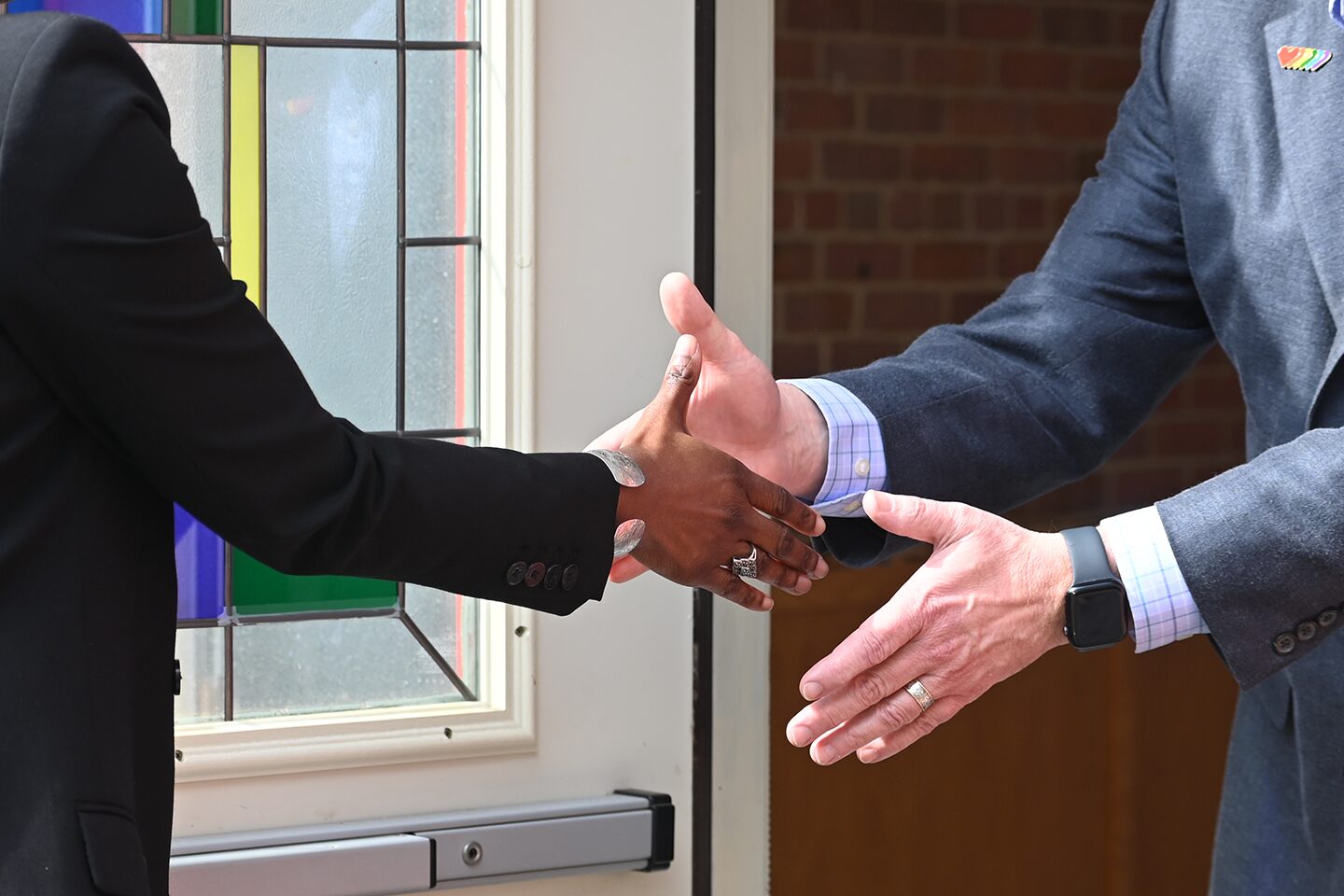
Jesus often got invited into people’s homes — for  celebrations, times of mourning, times of healing. As it was for Jesus, those in pastoral ministry are invited into the lives of others. It is a privilege and honor, for it opens new ways of being with and knowing others. Those who welcome us into their homes may or may not feel it is a gift (sometimes it is a bit of a bother), but we who are invited in know it is a gift.
I’ve often thought about the sign that says, “The Episcopal Church welcomes you.” It signals a willingness of the Church to be hospitable. The slogan, Invite Welcome Connect concerns just that…how to be a church that welcomes you.
From a pastoral perspective it is important for the Church to be hospitable. So yes, “The Episcopal Church welcomes you.” We want people to join us in our common life in Christ.
It’s also pastorally important to seek invitation into the lives of others. In this situation, the signs are less clear, and the slogans are mostly non-existent. I suppose there could be stickers on people’s house doors that say, “Episcopalians welcome here,” like “American Express welcome here” stickers at some business establishments. But we live in a world where invitation is cautious. Why would anyone welcome us in? Particularly if they felt generally unwelcomed in churches or by many church people. If we are cautious about offering refuge or sanctuary, or we are skittish about people different from ourselves (however defined), why should they welcome us?
The imaginary sticker invitation to the dwelling places of so many is really something like, “trusted friends welcom here.” When we are invited into people’s homes and lives, it is because there is a trust that we will somehow be with them in their hopes for healing, compassion, and the sharing of joys and sorrows. We are welcomed because we are trusted as companions, as people who share bread for the journey. Until trust is there, our intent to be “helpful” is met with a kind of suspicious gratefulness. When that trust is there, we cease being simply outsiders trying to do good, but friends.
In the past several months a small group at St. Peter’s Church in Lewes has been thinking about how they can be helpful to people in the immigrant community who seem to be in need of allies. (By immigrant community, I mean recent arrivals to the United States who find their primary community among others who share their language, culture, or national origin.) It’s clear that most of our pastoral work brings us into the homes of members of our own parish, very few of whom are from immigrant communities. What we realized is that we don’t have the sort of connections that would get us easily invited into the lives, homes, or churches of our immigrant neighbors. We don’t yet have connections of trust.
So, the question became, “how can we begin to connect, so that we become welcomed visitors, so that we are invited in?” How can we work to become allies, companions, trusted friends?
We think it’s important to try to become friends because we have the sense that Jesus was doing this all the time — finding ways to be invited into the lives of others so that they in turn could see his friendship as the assurance of God’s presence and blessing.
There are thousands of ways to do this. We are at the beginning stages of a rather simple effort to become welcome visitors and hopefully friends.
St. Peter’s Church has had a long-term relationship with the Church in Haiti. So, when we thought of migrant communities we wondered, what was going on in the Delaware Haitian communities? Can we help, or better can we stand with these immigrants? By building on several connections, i.e., a Haitian in-home care provider, La Esperanza Center in Georgetown, St. Luke’s Church in Seaford, and the Haitian Collective, we have begun a connection with a Haitian Baptist pastor and congregation in Seaford.
I met Pastor Markenson in Georgetown for coffee and began conversation. He invited me to services at his church. I’ve been twice, each time being graciously welcomed. I plan to visit regularly in the future, bringing some other members of St. Peter’s Church with me. The services are in Haitian Kreyol. As a non-Kreyol speaker, I am learning once again to be present without power or place, an outsider, welcome just as I am.
Pastor Markenson was invited to be part of a panel at a Speak Out Against Hate (SOAH) meeting in Lewes, Delaware. He and I are working together to develop a beginning English language class for some members from his church. Also, members of St. Peter’s Church attended an information session on Haitians in Delaware hosted by La Esperanza and The Haitian Collective. His congregation is working to become an official non-profit agency and we are hoping to assist them in the process.
All of this is part of a slow dance by which new bonds of friendship and trust might become a reality. From a “church” standpoint this can be seen as a form of outreach, or as an extension of Invite Welcome Connect. But perhaps it is also a way of slowly building the trust that might one day be called upon in a time of need. It might be part of the precursor to fully understanding what refuge and sanctuary is about.
The psalmist tells us that we find refuge and sanctuary under the wings of the Almighty, as it is written in Psalm 91:4: “Under His wings you shall take refuge.” Perhaps too, if we build a trusting relationship with others, we might be refuge and sanctuary for one another. But first we must be invited in, even as we invite others in.
Jesus got invited in, and it changed everything. When we get invited in, we are changed, and so are those who invited us. We become more mutually pastoral. Such mutuality is a gift, it is also always a work in progress.


No Place to Call Home:
Voices from the Streets
and a Faithful Response

The Route of Stone and Water:
Look Up
The Gift of Invitation:
Everything Changes
Bishop's Lenten Message:
Pray More, Scroll Less

It's 'T' Time!
Churches Can't Continue...