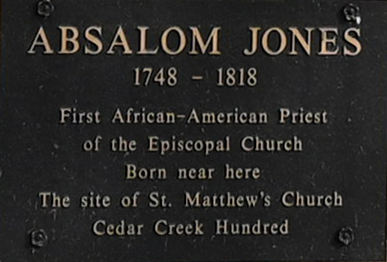
I can say with high confidence that information about Absolom Jones is scarce. Some of the events of his life represented in such documents as Lesser Feasts and Fasts and Holy Women Holy Men, have some details wrong or at best, out of order. There is little contemporary account of him. However, he is the saint from Delaware, and we should know what can be known about him. For the past several years, I have preached about Absolom Jones’ celebration on his feast day, February 13, which is conveniently during Black History Month.
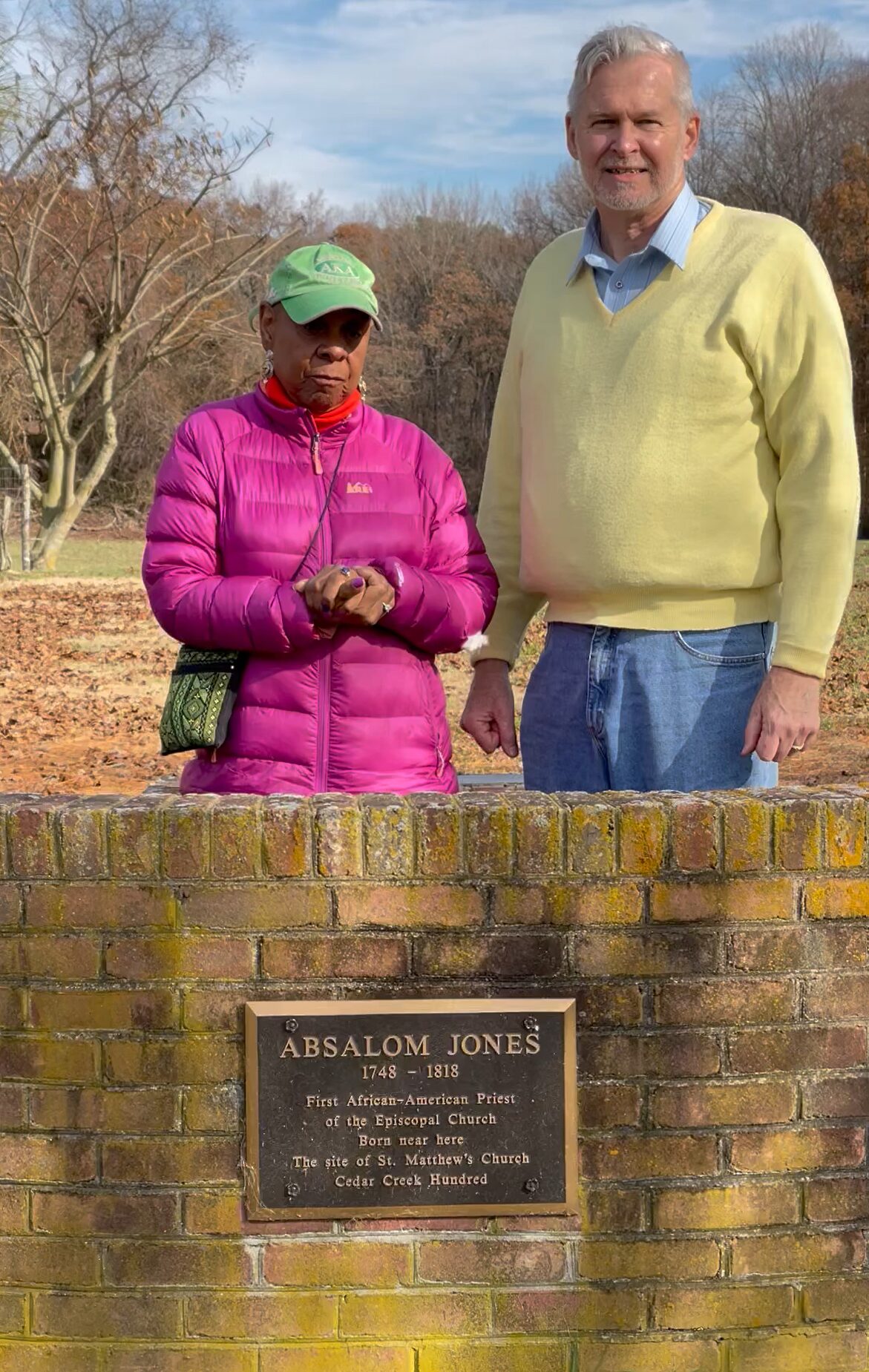
The Episcopal Church in Delaware should lead the Church in this celebration, because he was born as a slave in 1746 in the Cedar Creek Hundred in Sussex County on the farm of Abraham Wynkoop (an Anglican in good standing). In 1762, his enslaver, Abraham’s son Benjamin Wynkoop, sold Absalom’s mother, sister, five brothers, and his farm; however, he kept Absalom and moved to Philadelphia where Benjamin operated a dry goods store. This is the last we hear of Absalom Jones’ birth family, although there is evidence that Blessed Absolom wrote to his family once he learned how to read and write. Absalom was 16 years old.
The histories disagree on exactly where Absalom Jones learned to read, but they agree he was permitted to attend a night school in Philadelphia operated by the Friends. History also notes that Jones participated in the African community in Philadelphia, which included those free and enslaved.
In 1770, he married an enslaved woman, Mary Thomas, with the permission of both of their enslavers, and most importantly, Mary’s father, in an Anglican ceremony. Absalom basically ran a Go-Fund-Me to raise what he could, and he borrowed what he could not raise. Benjamin Wynkoop would not permit Absalom to purchase his manumission until 1784, the year after the end of the American Revolution and three years after the surrender at Yorktown. Some accounts suggest Benjamin Wynkoop granted the manumission without payment. So, imagine working, but someone being able to take not only all of your money, but all of the property you may have purchased; and imagine the greatest risk, that you could be forcibly separated from your family.
From 1762 to 1784, Absalom Jones had been worshiping at St Peter’s Anglican Church in Philadelphia. But likely, sometime after his manumission began worshiping at St George’s Methodist Episcopal Church. In 1787, along with his new best friend, Richard Allen (who is celebrated in another church for different reason) started a mutual aid society, the Free African Society. Both Jones and Allen were licensed to preach in the Methodist Episcopal Church. The active evangelism of these men lead to an increase in African membership at St. Georges’.
In 1791, the Vestry of St Georges’ decided the Africans should stay in the balcony instead of joining the entire congregation in prayer. They started enforcing this rule during a worship service and physically removed Absalom and other Africans during prayers of the people. The history is not clear on what exactly happened during this confrontation. Some accounts indicate they left during the service, while others say it was after the service. However, they all agree that when the praying stopped, Allen, Jones, and the rest of the Africans marched out of the parish.
In 1792, Jones and Allen started the First African Church. In subsequent years, Brother Richard started the African Methodist Episcopal Church. Blessed Absalom, to quote The Rev. Harold T. Lewis, former rector of Calvary Episcopal Church in Pittsburgh, Pennsylvania, “Jones toughed it out in the white establishment.” Eventually, the congregation applied for the group to join the Protestant Episcopal Church. Some of the activities of the Free Africa Society are discussed in the Ken Burns documentary “The American Revolution.”
In 1793, Philadelphia suffered an outbreak of Yellow Fever. Members of the Free African Society stayed, when everyone who could, left the city. Jones and Allen were trained as nurses. They, in turn, trained more nurses. Along with Dr. Benjamin Rush, one of the few doctors who remained, Jones and Allen tended to the sick and buried the dead. Eventually, in recognition of his witness and preaching, Absalom was ordained deacon in 1795 and priest in 1802.
Jones’ ministry was known for his preaching for abolition of slavery. One of his sermons is available online, and other topics that were well received in his congregation but may have not been as well received at other Episcopal parishes. His ministry was marked by tireless advocacy for the dignity and rights of African Americans, including petitions against slavery and the slave trade.
 It is the legacy of Absalom Jones, his faith, love, andfortitude in the face of systems that considered him “less than,” that Episcopalians celebrate each February 13. He represented both Godly love and prophetic witness. He was modest in manner but fiery in advocating for African community. Whatever he may have experienced, whatever pain and disappointment he endured, he is best understood as an exemplar of brotherly love, sisterly affection, passionate exhortation, and a firm belief that we are all one in Christ.