The Episcopal Church in Delaware
Delaware Communion Magazine | Winter 2025
- 302.256.0374
- www.delaware.church
Bishop's Address
241st Annual Convention
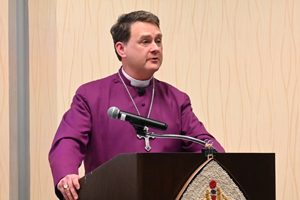
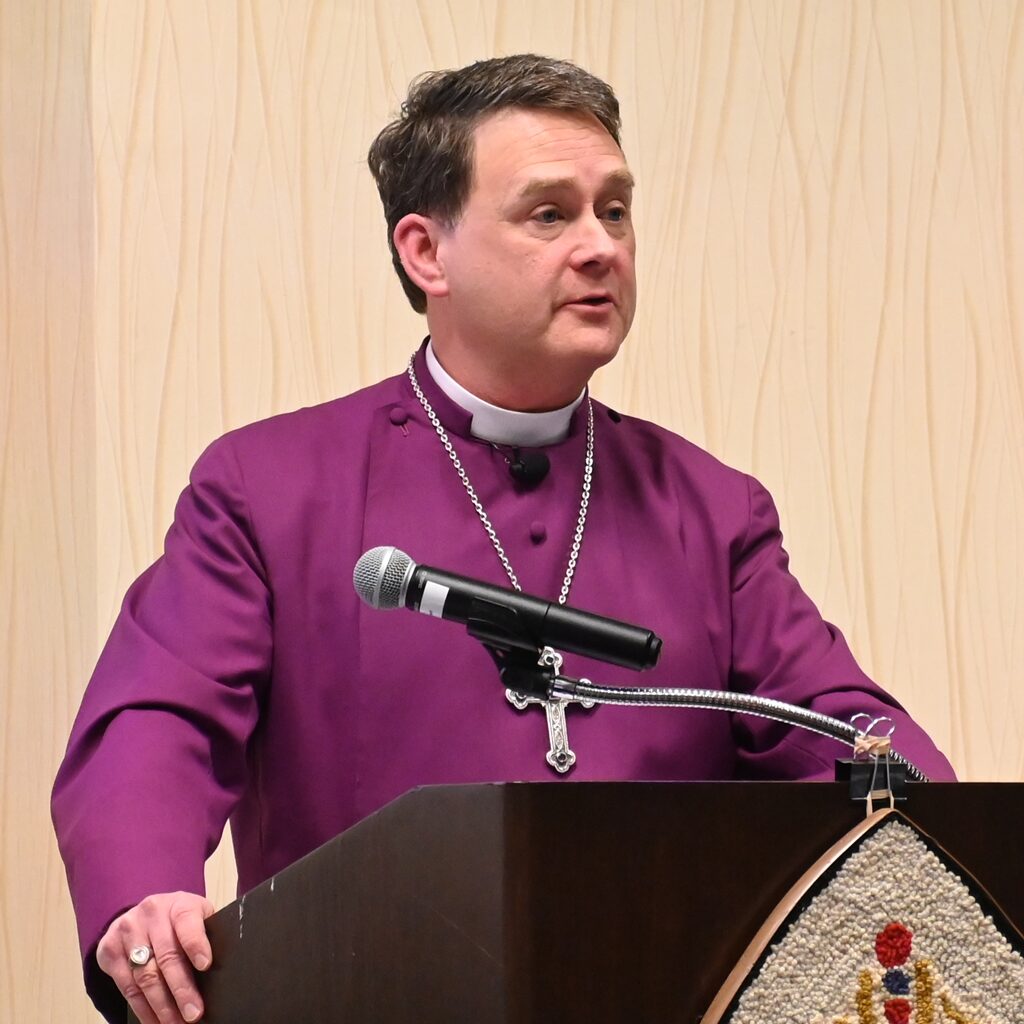
Bishop Kevin S. Brown delivers the bishop’s address at the 241st Annual Convention of the Episcopal Church in Delaware
[What follows is an edited transcription of Bishop Brown’s address, delivered at the 241st Annual Convention.]
Beloved of God in Delaware,
As we gather for this year’s convention, we are reminded that the work of organizing ourselves — appointments, certification of a quorum, approval of agenda, welcoming convention members, granting seat and voice, parish audits, recognitions, committee reports — is not merely administrative; it is essential. Through these efforts, we ground our shared ministry and prepare to act faithfully together — I am thankful to all of you for these good works. You can view much of this work in the Convention Guidebook, here.
I want to begin by reflecting on the past year and looking at the year to come. Our theme for the 241st Annual Convention comes from John 15, Jesus’ farewell discourse to his disciples. In verse 5, Jesus says, “I am the vine; you are the branches. Those who abide in me and I in them bear much fruit, because apart from me you can do nothing.”
This theme is about abiding and dwelling deeply in Christ. Amid all the important ministry to which we are called, we must remember that everything we do must be rooted in a deep dwelling in the Lord. He is the vine; we are the branches. The readings for the convention worship, taken from the lectionary for Easter 5 in Year B, include this passage.
Abiding, as it is used in this scripture, falls under our diocesan mission priority of discipleship, alongside growth, service, and unity as one church in Delaware. You can view the diocesan mission priorities here. Growth is intentional; churches grow because they seek to grow. Service is fundamental to our identity as the Church—we must love our neighbors as ourselves. And discipleship, reminds us that everything must be grounded in discovering and rediscovering Jesus Christ.
Discipleship may be a churchy word but think of it simply as discovery and rediscovery — encountering Christ again and again. We can do all the ministry in the world, all the service we want to, but if we are not abiding in Christ, if the branches are not attached to that vine, then our work is in vain. Likewise, we can invite people to church, but if we ourselves are not abiding in Christ, what exactly are we inviting them into?
This year, we lift up discipleship. We focused on growth in 2024 — when Stephanie Spellers invited us to tell our stories in Jesus Christ — and service in 2023, when Catherine Meeks reminded us that racial healing begins close in. This year, we focus on abiding and rediscovering Christ.
Discovering Christ and rediscovering is the lifelong call, finding the God who is always there. Consider the story of Peter. Peter met Jesus because Jesus met him first, calling him while he was tending his nets. Peter did not know everything that first day; he only knew that Jesus was a remarkable teacher and a miracle worker. Over time, Peter discovered more: that Jesus heals, feeds the hungry, rebukes demons, and challenges the status quo. The more Peter abided in Jesus and walked with him, the more deeply he got to know him. And then one day Peter was invited with James and John to a clouded mountaintop where he saw Jesus transfigured and, in a flash, he saw the glory of the living God. Peter didn’t get to know all of Jesus on day one. He had to keep discovering new truths about his Lord, new life and new possibilities. He discovered Jesus in the breaking of bread, in the resurrection, and in the forgiveness Jesus extended even after Peter betrayed him. Peter’s relationship with Jesus was a lifelong journey of discovery and rediscovery — just like ours.
Our walk in discipleship must be rooted in this ongoing discovery and rediscovery of Christ. Without it, all our ministries—our global partnerships, our reconciliation work, our parish programs—lose their grounding. If the work you are doing as a parish is not rooted in the discovery of Jesus Christ, in prayer and in worship, it’s not rooted in the one in which we abide. Like Mary at the feet of Jesus, we must abide. Like Martha, we serve. We need both.
This past year has been a robust year of ministry across our diocese. I feel the energy in your parishes. I want to highlight a few diocesan-wide efforts.
Governance Task Force
Last year, we formed the Task Force on Governance Structure and Mission, chaired by Michael Wood. They examined whether our governance structures are flexible and responsive enough to support our mission. Their work has resulted in two resolutions that have been put before convention. The adopted resolutions, submitted by Michael on behalf of the entire task force, can be found here. I am deeply grateful to Michael and his team; studying structure is rarely thrilling, but it matters because mission comes first.
Sanctuary and Immigration Enforcement
At the beginning of the year, we as a diocese looked at sanctuary and immigration enforcement. Many expressed concerns and many people across the diocese were worried about the reality, the possibility, that is, that a church would lose its historically privileged status — alongside schools and hospitals, churches were once seen to be deferred to in cases of immigration enforcement or law enforcement. In a time of heightened immigration enforcement, people were worried what this might do to a church and wondered if this is something that we should be concerned about?
If law enforcement does enter during church, what does a church do? Should we even be worried about such a thing? These were not hypothetical questions; they were urgent and real. People wanted knowledge. It is particularly confusing given that enforcement that is being discussed, and that is very much in our common life and our political discourse, is around a notoriously confusing topic — immigration and immigration status. Words like ‘illegal’ and ‘undocumented’ get passed around and people aren’t quite sure if we’re using the same language to describe the same people.
So, what did we do? Working with Episcopal Migration Ministries and the Chief Legal Officer of the Episcopal Church, and with support from our chancellor, we provided diocesan-wide education, including a Zoom workshop. We clarified basic misconceptions — for example, that the medieval notion of sanctuary as legal refuge does not apply today.
For some of us, the topic of immigration is immediately going to take our temperature up, and understandably so. It’s a major concern and topic for us as a nation and as a people.
We listened, we learned, and we summarized our findings in guidelines published in The Net eNewsletter in October. These guidelines were rooted partly in the wonderful work done in the Diocese of Olympia. It was not just us on the East Coast, but our brothers and sisters on the West Coast trying to come up with answers at the exact same time.
Diocesan Council reviewed and endorsed these guidelines in October, and we found that they are not only good for helping address the questions that people are asking, it is also a good resource for a question that came up at our convention in 2024. There was a floor resolution last year asking whether the Episcopal Church in Delaware should declare itself a Sanctuary Diocese. That resolution was tabled, largely because we lacked shared definitions and understanding. The newly published guidelines offer foundational clarity, though they do not tell us whether to adopt such a designation. They do, however, help us discern responsibly and faithfully the meaning of sanctuary. Most importantly, it gives people a host of resources and some basic knowledge — legal, historical, practical — so they can make ground decisions. Our work must be informed and wise — “wise as serpents and innocent as doves.” You can view the sanctuary document here.
Parish Transitions: Calvary Church, Hillcrest and All Saints’ Church, Delmar
We continue to see some post-COVID rebound in attendance, membership, giving, and parish energy. Many of our congregations — north and south, large and small — are experiencing renewed energy and enthusiasm for the work of the church. But this rebound is not universal.
In June, Calvary Church, Hillcrest closed after 170 years of loving ministry. The church leaders worked hard and describe that the final decision was made with a heavy heart, noting that, “For 170 years, Calvary Church, Hillcrest was a vibrant, thriving Episcopal church in North Wilmington and in the spring of this year, members were forced to make the extremely difficult decision to close. We had a robust and loving (leave-taking) Eucharist on the afternoon of June 1st.” You can view a video honoring their life and legacy here.
More recently, I met with every member of All Saints’ Church in Delmar during a parish meeting where they voted unanimously to close. While they were thankful for my invitation to come and speak to the convention body, they simply were unable to send delegates to be at convention. The convention body will hear from them through a video that I had asked our diocesan communications director, Cynde, to produce. You can view the video here. They are strong, faithful, and beloved.
And now, sisters and brothers, you have homework. At your December vestry meeting, I ask every parish — no matter your location — to draft a letter of invitation to the people of All Saints’, Delmar. Tell them you witnessed their video. Honor their history. Acknowledge their hard decision. Invite them into your parish home. It is good for them — and it is good for us. They need to know that in this time of sadness they are not alone. If helpful, you can send your letter to the Mission Support Office, 913 Wilson Road, Wilmington, 19803, and I will take it to them.
Their final service will be Sunday, January 25, at 2:00 p.m. If you have never been to Delmar, take this as your invitation. Come celebrate with Delmar. We will have a leave-taking service much like we had at Calvary Church this past June. That service was among the most powerful moments I have known as your bishop, and it was powerful because so many of you came. The church was full. One of their members said, “It has not been full like this in decades.” They were not sad, though, they were thrilled that so many of you were there. It matters.
The scheduled date of Sunday, January 25 may overlap with your favorite football team participating in a playoff game —but I promise you, these holy moments far outweigh anything happening on a field. I like football, too, but there’s football and then there’s life. Your presence in Delmar could make a profound difference to the people at All Saints’ and to us, and all you need to do is show up and love them.
The Wider Church
There is much happening beyond Delaware as well. Many have asked about the newly appointed Archbishop of Canterbury, the Rt. Rev. Sarah Mullally, Bishop of London. She will become the 106th Archbishop of Canterbury and the first woman to serve in this position, taking office in late January. The installation service, with all the pomp and circumstance, will take place in March. I’m thrilled for her appointment and have written to wish her every blessing in this most challenging role.
Closer to home, Province III — which I currently serve as President and previously as vice-president — is about to shift from 13 dioceses to 12. This mid-Atlantic province that Delaware is a part, includes dioceses as far north as the northern border of Pennsylvania and as far south as the southern border of Virginia. The dioceses of Bethlehem and Central Pennsylvania have voted to reunify, like reunifications we have seen in Wisconsin (Milwaukee, Eu Claire, and Fond du Lac) in 2024 and Michigan (Eastern and Western) also in 2024. The factors that impacted those dioceses are no different than the factors that impact our churches in Delaware. This is a dynamic time in the church and it is clear that structures that may have served us in the past may not be the exact ones that we need for today. It could be diocesan boundaries or parish boundaries — change is very much in the air. Our mission is ultimately what matters. Will our structures match and support the mission that is before us?
Looking Ahead
The Alaska opportunity I mentioned in last year’s convention address continues to unfold, and I will share more in the coming year.
Our global mission team is exploring potential mission work in Guatemala, partnering with the Diocese of Pennsylvania. It is uncertain how this will turn out, but it looks great and is filled with possibilities. I thank the global mission team for their work.
The Church of Sweden has also reached out, inviting us to consider a more formal relationship with their diocese, rooted in our shared history with Old Swedes Church — some Swedes settled on the Christina River and built Old Swedes Parish, and they still have great affection for the church here.
We will continue to support our many students in the Stevenson School. I am pleased to hear the appreciation that has been expressed for the classes — they are hard, but the professors are great. I am grateful to those who are investing in this work.
Going into 2026, I want to mention a new challenge that we, as trustees (as your bishop, I serve as president of the trustees) face, and it is growing: a portfolio of parish properties that come to the trustees to steward. We are blessed in this diocese to have the people and the resources to do this work. Quick decisions are not necessary, and the trustees are able to honor any existing contract that a closing church may have. For example, if that church is currently renting space to a preschool or has promised that a local group can stay through the end of the year, we are able to honor the contract. This is a real gift. The trustees were not formed initially to be property managers, but we will learn. We have a new capacity that we have to build. I mention this because I want to be real when we talk about things that are changing — when it is necessary to flex our structures to be able to respond accordingly. The trustees are accustomed to managing properties such as bishopstead or diocesan offices, but now we have church buildings that are becoming part of the portfolio, and it is no longer enough to just be a property manager. The big question: what are we going to do with the church properties? As trustees, we will learn how to do this important work and how to make the best decisions. We understand that these properties matter, and we need to be as good at managing properties as we are at managing investments. We are confident in this mission.
In Closing
I’m excited about focusing anew on our discipleship, on discovering and rediscovering Christ Jesus. Because in the end, all of our mission and all of our work has got to be rooted in him. “I’m the vine and you are the branches. Those who abide in me and I in them bear much fruit.” I believe that is what we all want desperately to do, to abide in our Lord and to bear fruit.
To the past year I thank you, to the year ahead I encourage you, and may we give thanks to God Almighty and celebrate together.
There’s plenty of good and holy work to do.
Amen.